

Couplings. What is the difference between rigid and flexible couplings?
Selecting the correct connection between two shafts ensures efficient operation of any equipment. If an improper coupling is used, even minor misalignments or vibrations can turn into serious problems such as accelerated wear, bearing loads, and potentially long shutdowns causing unexpected downtime.
There are two main types of couplings: rigid and flexible. Each type performs its function and works best under specific operating conditions.
What is a rigid coupling?
Rigid couplings are the simplest type of couplings that connect two shafts. The shafts must be perfectly aligned, as rigid couplings do not allow any misalignment. This is very difficult to achieve and rarely happens in practice.
Even with good initial alignment, changes may occur over time such as foundation settling or thermal expansion. A rigid coupling does not compensate for these changes and may lead to premature wear of transmission components. Rigid couplings are typically used in applications where precise rigid connection is required, such as machine tools or robotic assemblies.
Since they eliminate movement between shafts, rigid couplings provide stable torque transmission while maintaining precise alignment.
Design and functions
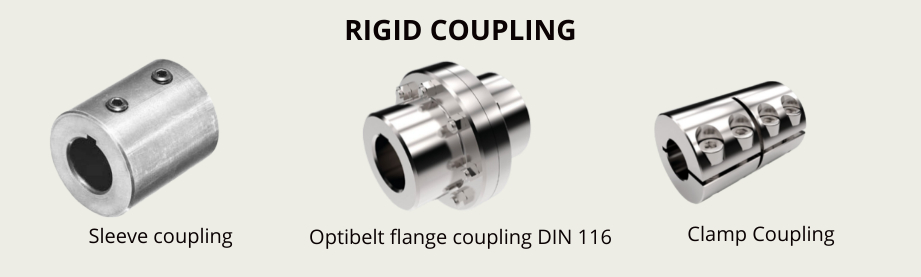
These couplings are typically made of steel, stainless steel, or aluminum, and use drilled holes, keyways, or set screws to secure the shafts to the coupling hubs. Some designs feature flanges or split clamps for easier installation and maintenance.
During operation, a rigid coupling transmits torque directly from one shaft to another without flexibility or damping. Due to this design, they ensure precise power transmission and perfect alignment.
However, these types of couplings cannot absorb vibration or accommodate misalignment. Therefore, rigid couplings are best suited for fixed, high-precision systems.
Examples of common rigid coupling types:
- Sleeve Coupling: This type uses a solid cylindrical sleeve to connect two keyed shafts, resulting in a strong connection for torque transmission.
- Flanged Coupling: Consists of two rigid flanged halves bolted together.
- Clamp Coupling: Consists of two split halves that are tightly fastened around the shafts.
Advantages:
✔️ Constant torque transmission – ensures torque transfer with minimal power loss, maintaining stable performance between connected shafts.
✔️ Simple, cost-effective design – features a straightforward design and is the least expensive type of coupling for power transmission.
✔️ Easy installation – due to their simple design, rigid couplings require minimal time to install.
✔️ Rigid coaxial shaft fixation – perfectly centers both shafts, creating a strong connection.
Disadvantages:
➖ No misalignment compensation – rigid couplings do not compensate for misalignment. Compensation of even slight misalignment between two shafts is required in most industrial applications to protect transmission components.
➖ No vibration damping – vibration naturally occurs in the system, and a rigid coupling does not damp any of it. This can lead to wear and premature failure.
➖ High alignment requirements – rigid couplings require precise alignment, which often means significant time and resource investment, and is not always practical.
What is a flexible coupling?
A flexible coupling connects two shafts while allowing slight movement or misalignment between them. It is designed to accommodate real-world imperfections that occur in rotating machinery.
Design and functions:
A flexible coupling connects two shafts while allowing a certain degree of movement between them. There are various types of flexible couplings that may use components such as elastomeric inserts, metallic discs, or spring elements that can flex during system operation. Flexible couplings absorb vibration, dampen torque peaks, compensate for misalignment, and protect other transmission components. This results in improved reliability and extended equipment service life.
Therefore, flexible couplings can be divided into two main categories – couplings where flexibility is achieved through material properties, and mechanical flexible couplings:
- Material-flexible couplings operate in shear or compression (due to stretching or compressing elastic materials such as rubber or special polymers, or due to deformation of thin metallic discs or springs) and can accommodate angular, parallel, and axial misalignment. These types of couplings do not require lubrication. (Jaw Couplings, Elastomeric Couplings, Disc Couplings, etc.)
- Mechanical flexible couplings compensate for misalignment through rocking, rolling, or sliding of metal components. All-metal mechanical flexible couplings require lubrication. (Gear Couplings, Grid Couplings, Roller Chain Couplings, etc.).
Examples of common types of flexible couplings:
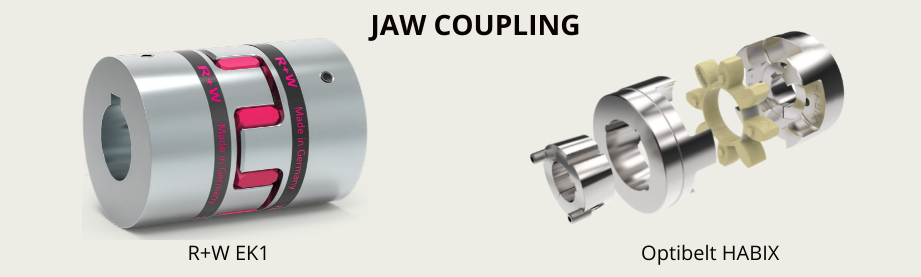
- Jaw Coupling: connects two hubs using an elastomeric insert that flexes during shaft rotation. This helps reduce vibration and noise while protecting other components from sudden torque spikes.
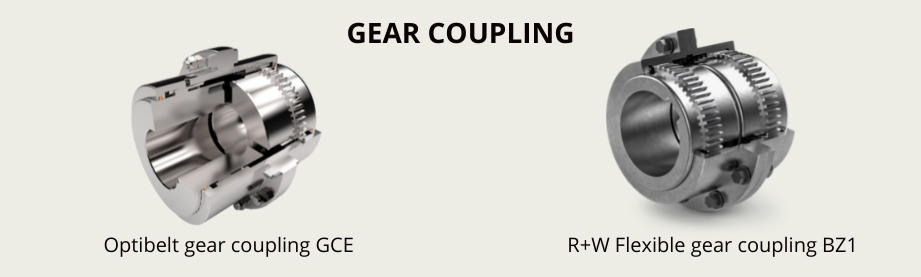
• Gear Coupling: this design uses lubricated teeth that mesh inside a sleeve, allowing misalignment to be accommodated.
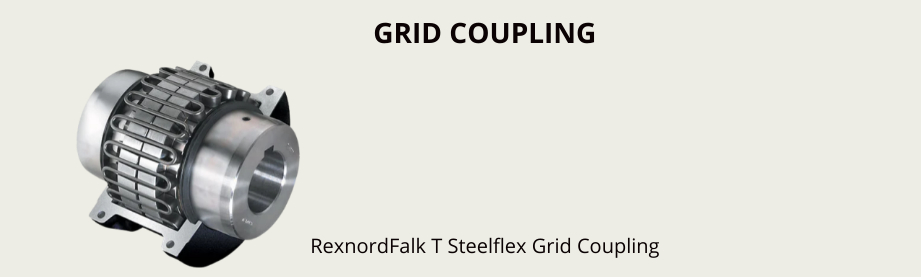
Grid Coupling: relies on a flexible steel spring element inserted into grooves on both hubs. The spring flexes slightly under load, helping to absorb shock loads.
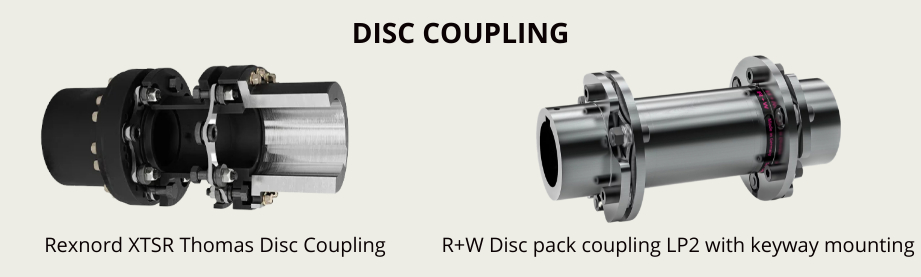
Disc Coupling: in this design, thin metal discs form the flexible element. They elastically deform to compensate for shaft displacement and misalignment.
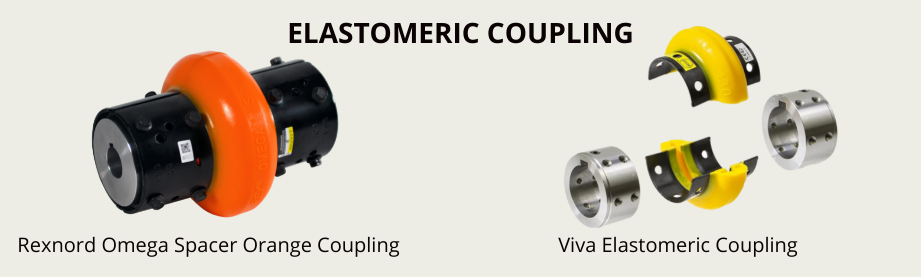
• Elastomeric Coupling: the design includes elastomeric inserts. This type of flexible element dampens vibration, compensates for misalignment, and is suitable for a wide range of industrial applications.
Advantages:
✔️ Vibration damping – helps smooth system operation by absorbing vibration and reducing noise, resulting in more efficient equipment performance.
✔️ Shock load protection – can soften sudden torque spikes and prevent damage to connected components.
✔️ Reduced wear – by lowering loads on bearings and seals, helps prevent premature wear and extends equipment service life.
✔️ Misalignment compensation – capable of compensating for slight angular, radial, or axial misalignment between shafts, maintaining stable torque transmission even as conditions change over time.
✔️ Long-term advantage – may have a higher initial cost and, depending on the coupling type, require more intensive maintenance. However, due to their ability to compensate for misalignment and reduce dynamic loads, their use leads to lower total operating and maintenance costs over time.
When should rigid or flexible couplings be used?
The choice between these two types of couplings depends on how your drive system operates. It is recommended to use a rigid coupling for high-precision setups. In contrast, flexible couplings should be used in systems where misalignment and vibration are present, as well as in systems where a protective function is required to prevent damage to costly transmission components.
When to use rigid couplings?
• Perfectly aligned, fixed shaft systems.
• High-precision drives, such as those used in CNC machines or robotic assemblies.
When to use flexible couplings?
• Industrial applications subject over time to vibration, thermal expansion, or misalignment.
• Systems where a protective function is required.
• Frequent start-stop cycles.


Comments